

Highlight
- Search intent is the reason behind a search query and Google ranks content based on how well it satisfies that reason.
- There are four types of search intent: informational, navigational, commercial investigation, and transactional.
- Content optimization in SEO means aligning your page’s format, depth, and messaging with what a searcher actually wants to find.
- Mismatched content leads to pogo-sticking where users return to Google immediately — which signals poor relevance to the algorithm.
- Identifying intent correctly before you write is the single most efficient way to improve your organic rankings.
What Is Search Intent (and Why Google Cares About It)?
Search intent, sometimes called keyword intent or user intent, is the underlying goal a person has when they type a query into Google. They might want to learn something, find a specific website, compare options, or make a purchase. These are four distinct states of mind, and Google has spent years getting better at detecting which one applies to any given search.
This matters because Google’s core job is to return the result that best satisfies the searcher, not the result with the most keyword mentions. Two pages could both target the phrase “SEO services Australia” and receive entirely different treatment in the rankings because one of them answers what the searcher actually wants, and the other does not.
Matching your content to search intent is not optional. It is the foundation of content optimization SEO.
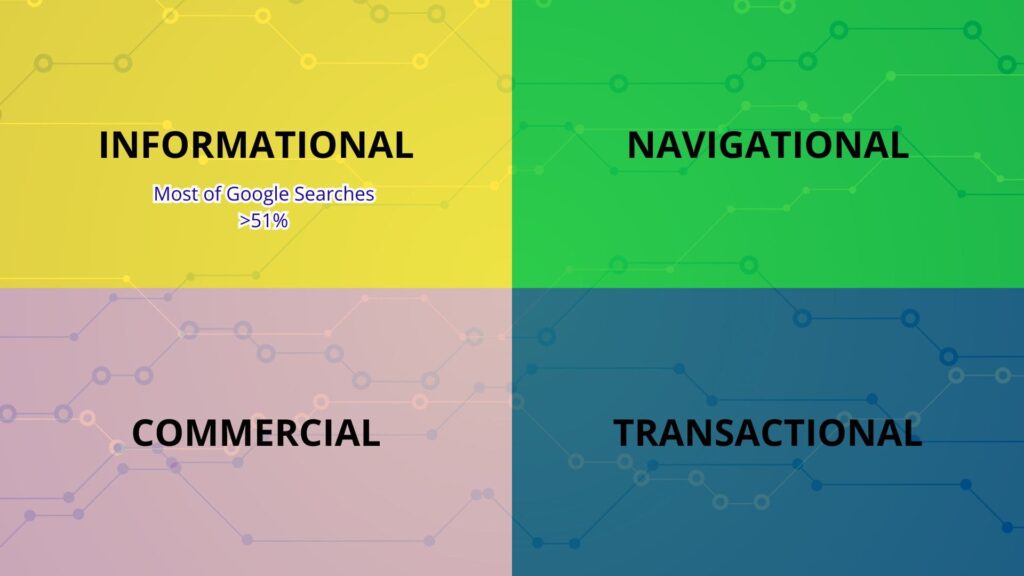
The 4 Types of Search Intent Explained
Informational
The searcher wants to learn something. They are not ready to buy so they are still looking for answers, explanations, or guidance. According to SparkToro, informational intent accounts for more than 51% of all Google searches, making it by far the most common query type.
Examples: “what is SEO,” “how does Google’s algorithm work,” “why is my website not ranking.”
The right content format here is a clear, well-structured article or guide, one that answers the question directly and covers the subtopics a reader would logically want to understand next.
Navigational
The searcher is trying to reach a specific destination like a website, a login page, or a brand. SparkToro data shows navigational intent makes up around 32% of searches. These users already know where they want to go, so targeting navigational queries rarely makes sense unless the query involves your own brand name.
Examples: “Ahrefs login,” “Semrush pricing page,” “Rhasko Digital blog.”
Commercial Investigation
The searcher is considering a purchase or service but has not decided yet. They are comparing options, reading reviews, and weighing up providers. This intent is high-value for service businesses because the searcher is already in buying mode but just not ready to commit.
Examples: “best SEO agency for small business,” “Semrush vs Ahrefs,” “SEO services cost Australia.”
The right format here is a comparison article, a detailed listicle, or a case study-backed guide. A generic service page will not rank for these queries.
Transactional
The searcher is ready to act. They want to buy, book, sign up, or contact someone. These queries carry the highest commercial value and are typically the hardest to rank for organically because competition is intense.
Examples: “hire SEO agency Sydney,” “SEO audit service,” “buy SEO package online.”
| Intent Type | Example Query | Best Content Format |
| Informational | “what is on-page SEO” | Educational article, how-to guide |
| Navigational | “Ahrefs login” | Brand page or homepage |
| Commercial Investigation | “best SEO tools for small business” | Comparison article, listicle |
| Transactional | “hire SEO agency Melbourne” | Service page with clear CTA |
What Is Content Optimisation in SEO?
Content optimisation in SEO is the process of improving an existing or new piece of content so it fully satisfies the intent behind a target keyword, while also meeting the technical and structural signals Google uses to evaluate quality.
It is not about stuffing more keywords into a page.
A practical example: a plumbing business publishes a blog post titled “Hot Water System Repair” that reads like a sales pitch. Someone searching that phrase wants step-by-step troubleshooting guidance, not a quote request form.
The content fails to match intent — so it ranks poorly despite being technically well-optimised.
True content optimisation means asking: what does this searcher actually need, and have I provided it in the most useful format possible?
Why Matching Content to Search Intent Matters for Rankings
When a page fails to match intent, users do not stay. They click back to Google and try another result. This behaviour is called pogo-sticking, and it is one of the clearest signals that a page is not delivering on its promise.
Google tracks what happens after a user clicks a search result. If someone lands on your page and immediately returns to the SERP to try a different result, that is a strong signal that your content did not satisfy what they were looking for.
A 2024 leak of internal Google documents confirmed that Google tracks “long click” behaviour — how long a user spends on a page before returning to search results, as part of how it evaluates content quality.
The practical consequence is straightforward: a page optimised purely for keywords but misaligned with intent will struggle to hold its rankings over time, regardless of how many backlinks it has accumulated.
Google’s algorithm is increasingly good at detecting the difference between a page that ranks and a page that satisfies.
How to Identify the Search Intent Behind Any Keyword
Step 1: Analyse the SERP Yourself
Before you write a single word, search your target keyword in Google. Look at what is already ranking on page one. If the top results are all listicles, the intent is informational and the expected format is a list. If they are all product or service pages, the intent is transactional. Google has already done the intent classification so you just need to read what it is showing you.
Step 2: Look at the Content Format
Format is a secondary signal. How-to guides indicate a learner. Comparison tables indicate a shopper. Definition pages indicate early-stage curiosity. Each format carries implicit information about what the searcher wants and matching that format is often as important as matching the topic itself.
Step 3: Check the People Also Ask Box
The PAA box shows you the sub-questions searchers commonly have around a keyword. These are the gaps your content should fill.
If you are targeting “what is content optimisation,” and the PAA box includes “how do you optimize content for SEO” and “what tools are used for content optimisation,” those subtopics belong in your article.
How to Optimise Your Content for Search Intent (Step by Step)
Match Your Content Format to the Intent
Do not write a long-form educational guide for a transactional keyword. Do not build a service page for an informational one. Format determines whether a user stays and whether Google rewards you. Check what the top three results are doing before you decide on structure.
Cover the Topic Comprehensively, Not Exhaustively
Comprehensive means you have answered every question a reasonably curious reader would have about this topic. Exhaustive means you have padded the article to hit a word count.
These are not the same thing. A 1,200-word article that answers every relevant question outperforms a 3,000-word article full of repetition.
Optimise Your Title Tag and H1 for Intent Signals
Certain words communicate intent directly. “How to” signals informational. “Best” signals commercial investigation. “Hire” or “buy” signals transactional. Use these deliberately in your title tag and H1 so both Google and the searcher immediately understand what kind of content they are getting.
Update Content Regularly
Informational articles citing data from two or three years ago lose authority fast — especially in fields like SEO and digital marketing where the landscape shifts year to year. A content refresh with updated statistics and revised examples is often faster and more effective than writing a new article from scratch.
Content Optimisation Tools Worth Knowing
Several tools assist with content optimisation SEO by analysing top-ranking pages and identifying gaps in your own content.
Surfer SEO analyses the structure, word count, and keyword distribution of ranking pages and produces a content score for your draft.
Clearscope focuses on semantic relevance, identifying related terms and questions your content should address.
Frase combines SERP analysis with an AI-assisted writing environment, useful for structuring articles around intent quickly.
NeuronWriter is a cost-effective alternative popular among solo operators and small agencies.
None of these tools replace the judgement involved in reading a SERP and understanding what a searcher actually needs. They are aids, not substitutes.
Common Mistakes When Optimising Content for SEO
Targeting the wrong intent entirely. Writing an educational article for a keyword where Google is ranking service pages or vice versa is the most common and costly content mistake.
Optimising for keywords without checking the SERP first. A keyword with decent monthly search volume can still carry an intent that does not match your business goals. Checking the SERP takes two minutes and prevents wasted effort.
Using the same format for every article. Not every topic calls for a listicle. Some require a step-by-step guide. Others need a direct definition followed by practical application. Format variety also improves user experience across your blog.
Treating content optimization as a one-time task. A page optimised well in 2023 may need revision now. Competitor pages improve. Search behaviour shifts. Google’s understanding of intent evolves.
Treating content as a living asset, not a published document, is what separates consistently ranking sites from those that stall.
Ignoring the PAA box. Leaving out the sub-questions that Google has already identified as closely related to your keyword is a missed opportunity for both comprehensiveness and featured snippet eligibility.
Putting It Together
Search intent is not a technical SEO concept but it is a user psychology concept. Google has built its entire quality evaluation system around the idea that the best result is the one that most fully satisfies what the searcher came to find.
Content optimisation, by extension, is the discipline of closing the gap between what your page currently offers and what the searcher actually needs. Get that alignment right, and rankings, dwell time, and conversions tend to follow.
If you want help auditing your existing content for intent alignment or building a content strategy that targets the right queries from the start, get in touch with the Rhasko Digital team.