

An internal linking strategy is a structured approach to connecting pages within the same website to guide users and search engines toward the most valuable content.
When done correctly, it strengthens your site architecture, improves discoverability, and supports higher rankings for important pages.
In today’s competitive search landscape, internal linking is more than a basic SEO task. It is a strategic framework that helps search engines understand your content hierarchy and helps readers navigate naturally toward the information or offers they need.
Strong internal links improve crawl paths, distribute authority across your pages, and increase engagement by keeping visitors exploring your site longer.
For businesses and website owners, this translates into better visibility, more qualified traffic, and higher conversions.
This article will walk you through practical, actionable methods to build internal links that support real SEO growth.
You will learn how anchor text shapes relevance signals, how search engines evaluate link relationships, and how to create a structured content network that elevates your most important pages.
Each section is designed to deliver insight you can apply immediately to strengthen the performance of your website.
Read this article to learn how to:
- Build a strong page network that improves ranking potential
- Use anchor text effectively to communicate content relevance
- Plan links that support your business goals and content priorities
- Avoid common internal linking mistakes that limit performance
Stay with this guide to gain a complete understanding and unlock the full benefits of a powerful internal linking structure for your business.
How Internal Links Work in SEO (The Core Mechanism)
Internal links are one of the structural elements that help search engines understand your website. They connect related pages so Google and users can move through your content logically.
When search engines follow these links, they form a clear picture of your topic structure, identify which pages are more important, and determine which pages should appear in search results.
Internal links support search performance by improving how pages are discovered, indexed, and ranked.
Without an intentional internal linking strategy, even great content can remain hidden or underperform because search engines cannot easily locate or evaluate its relevance. Instead of acting as isolated pages, well-linked content forms a strong, interconnected network that supports higher visibility and ranking strength.
1. The Two-Fold Role: Mapping Relationships and Enhancing Indexability
Search engines rely on internal links to interpret how pages relate to one another. When you link from one page to another, you are signaling context, priority, and topical grouping. This process is essential for semantic understanding, especially when your content is built around topic clusters or a pillar page model.
Internal links also help with indexability. Search engines use automated crawlers to move through links and discover new pages.
If a page has no internal link pointing to it, or only has weak connections, crawlers may not reach it efficiently. These pages are often called orphan pages, and they struggle to appear in search results because they are disconnected from your website structure.
Good linking also improves user navigation. When visitors are guided to relevant supporting content, they stay longer and engage more deeply.
This increased engagement signals quality and clarity to search engines, which supports ranking strength. Even without relying on external links, a well-designed internal linking system can lift page performance simply by improving accessibility and context.
To strengthen the mapping and indexability role of internal links, consider:
- Linking contextually within the body of content, not only in navigation menus
- Connecting supporting articles to primary pages or commercial pages
- Using logical link placement that helps users continue their journey naturally
- Reviewing older content and updating links as your site grows
Internal linking is not about adding random blue text. It is a deliberate framework that structures how both people and search engines interpret your website.
2. Distributing Power: PageRank and Authority Flow
Internal links also distribute authority across your website. Every page has a certain level of value based on performance, relevance, and the links pointing to it.
When you link from a strong page to another page, you pass a portion of that authority. This process is commonly known as PageRank flow, and while the original formula has evolved, the concept remains a foundational ranking factor.
Authority distribution determines which pages search engines view as the most important. If all your internal links point to irrelevant or minor pages, you divide your strength without purpose.
However, if you deliberately point internal links to strategic pages, such as conversion pages, pillar articles, or high-value content, you guide search engines to recognize their importance.
Authority flow works best when:
- High-authority pages link to priority pages you want to rank
- The number of links remains balanced to avoid dilution
- Links are placed in meaningful content areas where users engage
- You plan linking based on structure, not on random placement
This mechanism also supports topic clustering. When related pages within the same category link together, search engines view the entire group as a strong topical resource. That helps your site compete more effectively even in competitive search categories.
Authority flow is one of the strongest reasons internal links are essential. You do not need hundreds of external backlinks to improve rankings; sometimes, restructuring internal links can deliver noticeable improvements on its own.
A strategic internal linking ecosystem strengthens the entire website rather than individual pages standing alone.
Key Takeaways
- Internal links help search engines understand content relationships and discover pages efficiently
- A strategic structure improves indexability and prevents orphan pages from being overlooked
- Internal links distribute PageRank and authority to elevate important pages
- Linking intentionally within topic clusters strengthens ranking potential across the site
Types of Internal Links
Internal links come in several forms, each serving a different purpose in shaping navigation, relevance, and authority flow. Understanding these types helps you build a balanced structure that supports both users and search engines.
The key is using the right link type in the right context to create a strong, intuitive path through your website.
1. Navigational Links
Navigational links are structured links found in the main menu, footer, and primary navigation elements. They guide users to top-level pages such as service pages, category pages, or contact pages.
For search engines, these links define the core structure of your website and identify the highest priority pages. While they do not provide as much contextual relevance as in-content links, they are essential for accessibility and hierarchy clarity.
2. Contextual Links
Contextual links are placed naturally within the body of content, surrounded by relevant text. These links send strong relevance signals about the destination page because the surrounding context explains the relationship.
Contextual links often drive the highest engagement and authority transfer. They are key components of topic clusters, where supporting articles strengthen a pillar page.
3. Sidebar and Related Content Links
These links appear in areas such as sidebars or widgets suggesting related content. They help users stay engaged and move deeper into the site even when they are not actively searching for more information.
While they may not carry as much ranking power as contextual links, they contribute to improved navigation and session duration.
4. Breadcrumbs
Breadcrumbs show a page’s location within the site hierarchy, such as Home > Category > Subpage.
They provide internal linking support and help users understand where they are. For search engines, breadcrumbs reinforce structure clarity and help connect categories and subpages efficiently.
Key Takeaways
- Each internal link type supports structure, navigation, and authority differently
- Contextual links are the strongest for relevance and ranking impact
- Combining multiple link types builds a more complete and user-focused website structure
Anchor Text: Definition, Types, and Best Practices
Anchor text is the clickable text used to link from one page to another. It tells both users and search engines what the target page is about.
Because anchor text shapes relevance signals, it plays a central role in refining your internal linking strategy. The more accurate and descriptive the anchor text, the easier it is for search engines to understand context and connect meaning across pages.
For users, well-crafted anchors improve clarity and encourage them to continue reading.
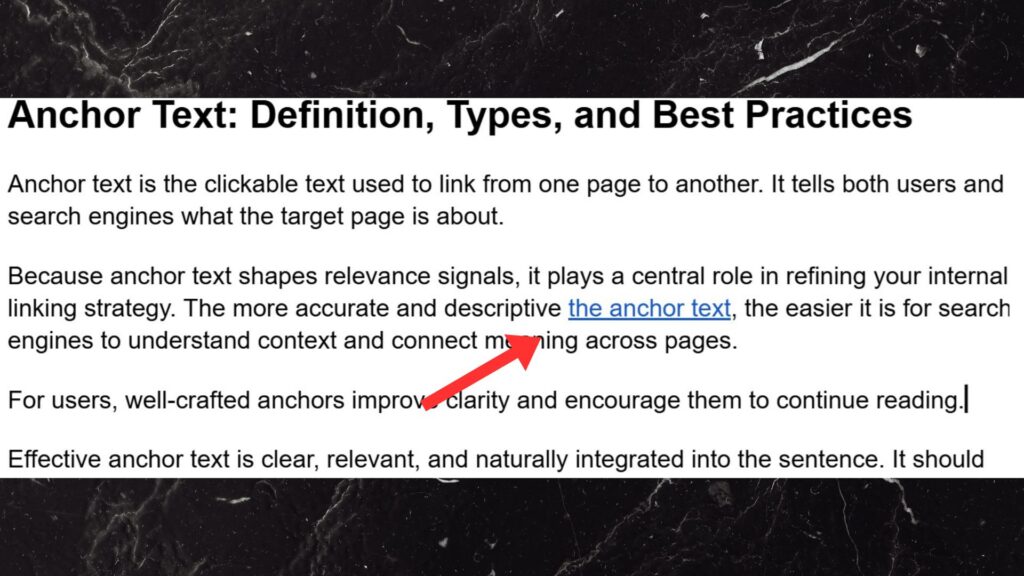
Effective anchor text is clear, relevant, and naturally integrated into the sentence. It should not be stuffed with keywords or written awkwardly.
When anchor text is over-optimized, it may appear manipulative and weaken the quality of the content. A balanced approach improves authority transfer and strengthens topic alignment within your content network.
1. Types of Anchor Text (With Examples)
Different types of anchor text support different strategic goals. Using a mix helps maintain a natural profile and provides richer context.
Exact match anchor text
Use the precise keyword you want to rank for.
Example: linking with the anchor text internal linking strategy to a page that targets that phrase.
Partial match anchor text
Includes a variation or part of the target keyword.
Example: how to build internal links effectively
Branded anchor text
Uses the brand or company name.
Example: Rhasko Digital SEO Resources
Generic anchor text
Uses non-descriptive phrases.
Example: read more, learn here, visit this page
Long-tail descriptive anchor text
Uses a more detailed phrase explaining expectations.
Example: guide to improving on-page structure using internal links
The goal is to keep anchors relevant to the destination page and fit naturally into the sentence structure. Using only exact-match anchors may look manipulative, while relying only on generic anchors loses relevance value.
2. Best Practices for Anchor Text Optimization
Good anchor text supports both users and search engines. To optimize anchors effectively:
- Write anchors that describe what users will find after they click
- Avoid repeating the same keyword anchor across many pages
- Place anchor text within meaningful, high-value content areas
- Do not force anchors into places where they disrupt natural reading
- Link only when the destination page adds real value to the topic
Anchor text is a precision tool, not decoration. When used with intent and clarity, it strengthens topical connections and lifts the ranking potential for priority content.
Key Takeaways
- Anchor text shapes relevance signals and helps search engines interpret linked content
- Use a balanced mix of anchor text types for natural distribution and clarity
- Avoid keyword stuffing and focus on context-driven placement
- Strong anchor text improves user understanding and supports higher ranking performance
Strategic Internal Linking Methods
Internal linking works best when executed as a structured system rather than adding links randomly.
A deliberate approach helps you guide users through logical content paths and support the authority needed for priority pages to rank.
The following methods provide a practical framework you can apply to improve clarity, engagement, and ranking performance.
1. Build Topic Clusters and Link to a Pillar Page
A topic cluster structure connects multiple related articles to a central pillar page. This helps search engines understand your expertise and improves overall thematic relevance across your site.
To apply this method:
- Create one in-depth pillar article that covers the main topic comprehensively
- Write supporting articles focusing on narrower subtopics
- Link from each supporting page back to the pillar page using relevant contextual anchor text
- Interlink the supporting pages with each other where appropriate
This structure helps search engines recognize depth and builds visibility across the cluster rather than relying on a single page.
2. Prioritize High-Value Pages
Not all pages need the same number of internal links. Focus on pages that contribute directly to business goals, such as revenue pages, conversion pages, or key informational resources.
Steps to prioritize:
- Identify pages with strategic value: service pages, money pages, or strong resources
- Add contextual links from high-performing pages to these key pages
- Use anchor text that reflects clear relevance and intention
- Review performance regularly and adjust based on traffic and engagement
This ensures PageRank flows to pages that matter most.
3. Link from High-Authority Pages
Pages with strong engagement or external backlinks often carry more authority. Linking from these pages helps distribute strength across your site.
How to identify authority pages:
- Look for pages with consistent organic traffic
- Check engagement signals such as time on page and number of visitors
- Use internal analytics to find top-performing articles
Once identified, link these pages to important destinations to reinforce their ranking potential.
4. Avoid Orphan Pages
Orphan pages have no internal links pointing to them, making them nearly invisible to search engines.
Reduce orphan pages by:
- Auditing your site to locate pages with zero inbound internal links
- Adding internal links from relevant content
- Including them within topic clusters if appropriate
Every important page should have multiple paths leading to it.
5. Use Contextual Placement for Maximum Impact
Links placed within the body of content carry stronger value because they provide richer context and higher click probability.
Best placement practices:
- Add links near sections where the reader may need deeper information
- Place links early enough so they are easily found
- Avoid clustering too many links in a single sentence or paragraph
The strategic placement of these links should prioritize the reader’s journey, guiding them to relevant resources precisely when their curiosity is piqued.
Key Takeaways
- Build topic clusters and connect supporting content to pillar pages
- Prioritize internal links to high-value pages that support business goals
- Link from high-authority pages to strengthen ranking performance
- Prevent orphan pages by ensuring each page has inbound internal links
Dofollow vs Nofollow and How Internal Links Differ from Backlinks
Many website owners are confused about whether they need to change internal links to nofollow or keep them dofollow. Also the differentiation between Internal Link and Backlinks
1. Dofollow vs Nofollow Explained
In reality, internal links are dofollow by default, and that is usually the correct setting. Dofollow links allow search engines to crawl the destination page and pass authority, which helps with ranking and indexing.
Nofollow, on the other hand, tells search engines not to follow the link or pass authority. It is not meant for regular content linking.
When to use each:
- Dofollow (recommended for most internal links):
- Helps search engines reach pages and understand structure
- Passes PageRank and strengthens important pages
- Improves topical relevance and indexing
- Nofollow (use sparingly):
- For pages that do not need to appear in search results, such as login pages or checkout pages
- For temporary or sensitive pages where authority shouldn’t be transferred
- When managing crawl budget for very large websites
Using too many nofollow internal links can break the natural flow of authority and weaken SEO performance.
2. Internal Links vs Backlinks
Another common confusion is treating internal links and backlinks as interchangeable. They serve very different purposes.
Key differences:
- Internal links
- Connect pages within the same website
- Control site structure, navigation, and authority distribution internally
- Fully controlled by the site owner
- Backlinks
- Links from external websites to yours
- Act as third-party endorsements and typically carry stronger ranking influence
- More difficult to obtain and depend on external trust
Both link types are important. Internal links build a strong foundation and help search engines understand your content; backlinks help prove credibility and build external reputation. Without internal structure, backlinks cannot perform effectively.
Key Takeaways
- Use dofollow for most internal links to support authority flow and indexing
- Apply nofollow only for pages that should not rank or pass value
- Internal links shape structure; backlinks build external trust and credibility
Internal Linking Mistakes to Avoid
Even with good intentions, internal linking can fail if executed poorly. Certain mistakes weaken authority flow, confuse users, and prevent search engines from understanding your content structure.
Avoiding the following errors will help protect your ranking potential and improve user experience.
1. Adding Links Without Strategy
Randomly placing links just to increase link volume does more harm than good. Without context or purpose, internal links become noise and dilute clarity. Every link should support a clear journey or business goal.
Avoid: inserting links where they don’t contribute useful direction or context for the reader.
2. Over-Optimizing Anchor Text
Using the exact same keyword-heavy anchor repeatedly can appear manipulative and disrupt natural reading flow. This may lead to reduced trust and weaker performance.
Avoid: forcing exact-match anchors in every instance. Use natural and varied language instead.
3. Linking to Too Many Pages from One Area
Too many links clustered together confuse users and weaken authority distribution. When everything is emphasized, nothing stands out.
Avoid: adding long lists of links or stuffing links inside a single paragraph without hierarchy.
4. Ignoring Orphan Pages
Pages with no internal links pointing to them are difficult for search engines to crawl and rarely perform well.
Avoid: publishing content without integrating links from existing relevant pages.
5. Linking to Irrelevant Content
Relevance is the foundation of effective linking. If links feel forced or off-topic, users will ignore them and search engines will devalue them.
Key Takeaways
- Add links with intent and relevance, not volume
- Keep anchor text natural and varied
- Avoid link clusters that overwhelm users
- Make sure every important page receives internal links
Actionable Checklist: How to Build an Effective Internal Linking Strategy
Use this practical checklist to turn concepts into a structured internal linking plan you can apply immediately. Follow each step in order to ensure clarity, consistency, and measurable impact.
1: Strategy and Structure
- Identify your most valuable pages: key service pages, product pages, pillar articles, or high-conversion resources
- Build topic clusters around key themes and link supporting content to pillar pages
- Make sure every important page has multiple internal paths pointing to it
2: Content-Level Linking
- Add contextual internal links naturally within the body text, where they make sense for the reader
- Place links where users may seek deeper information or related topics
- Use clear, descriptive anchor text aligned with page relevance
3: Authority Management
- Link from high-performing pages with strong engagement or external backlinks
- Avoid sending excessive links from one page; focus on priority pages
- Review and adjust internal link flow regularly based on analytics
4: Technical and Structural Maintenance
- Audit your site to locate orphan pages and connect them appropriately
- Ensure navigation menus, breadcrumbs, and related-content widgets support usability
- Keep internal links dofollow unless a page should not pass authority
5: Quality Control
- Check for broken internal links and fix or redirect them
- Prevent over-optimized keyword repetition in anchor text
- Confirm that each link adds real value to user experience
Key Takeaways
- Build structure first, then optimize links within content
- Prioritize high-value pages and contextual placement
- Maintain links with regular audits and performance reviews
Conclusion: The Next Step You Must Do
A strong internal linking strategy is one of the most reliable ways to improve website performance and long-term organic growth.
By structuring pages intentionally, using clear anchor text, prioritizing valuable content, and maintaining link quality, you help both users and search engines understand your site more effectively.
Internal linking is not just a technical SEO task; it is a strategic framework that supports discoverability, authority distribution, and engagement. When your website is easy to navigate and your content is connected logically, every page performs better.
Beyond internal linking, modern search success also depends on a broader approach that includes SEO, AEO, and GEO:
SEO (Search Engine Optimization) strengthens visibility in traditional search engines and helps your content rank competitively.
AEO (Answer Engine Optimization) improves your ability to appear in AI-powered search environments and deliver direct, concise answers that users expect in conversational search.
GEO (Generative Engine Optimization) adapts content for AI-generated summaries, ensuring your brand is represented accurately inside AI results.
These three layers position businesses to succeed across search experiences today and in the future. At Rhasko Digital, specialize in SEO, AEO, and GEO strategies designed to help businesses increase authority, attract qualified traffic, and convert more customers.
With a foundation of smart internal linking and modern search optimization, your website can become a powerful engine for growth, credibility, and long-term competitive advantage.
Free Consultation to info@rhaskodigital.com